




 My Wish List

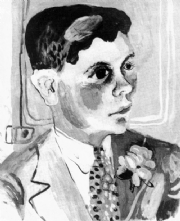
Vernon Duke
Vernon Duke (10 October 1903 – 16 January 1969) was a Russian-born American composer and songwriter who also wrote under his birth name, Vladimir Dukelsky. He is best known for "Taking a Chance on Love," with lyrics by Ted Fetter and John Latouche (1940), "I Can't Get Started," with lyrics by Ira Gershwin (1936), "April in Paris," with lyrics by E. Y. ("Yip") Harburg (1932), and "What Is There To Say," for the Ziegfeld Follies of 1934, also with Harburg. He wrote the words and music for "Autumn in New York" (1934) for the revue Thumbs Up! In his book, American Popular Song, The Great Innovators 1900-1950, composer Alec Wilder praises this song, writing, “The verse may be the most ambitious I’ve ever seen." Duke also collaborated with lyricists Johnny Mercer, Ogden Nash, and Sammy Cahn.
The Dukelskys resided in Kiev, and Vladimir's only visit to Saint Petersburg and Moscow occurred in the summer of 1915. The impressions of that summer were later echoed in Dukelsky's oratorio The End of St. Petersburg (1931–37). The title is a reference to the film The End of St. Petersburg, directed by Vsevolod Pudovkin.
At the age of eleven, Dukelsky was admitted to the Kiev Conservatory, where he studied composition with Reinhold Glière and musical theory with Boleslav Yavorsky. In 1919, his family escaped from the turmoil of civil war in Russia and spent a year and a half with other refugees in Constantinople. In 1921, they obtained American visas and sailed steerage class on the SS King Alexander to New York.
He underwent his immigration inspection at Ellis Island. On the passenger list, the purser of the King Alexander recorded his name as Vladimir Doukelsky, in the French fashion. In 1922 in New York, George Gershwin befriended the young immigrant. Gershwin (born Jacob Gershwine) suggested that Dukelsky truncate and Americanize his surname, taking Vernon as his given name. Dukelsky's first songs published under his pen name were conceived that year, but he continued to write classical music and Russian poetry under his birth name until 1955.
As a classical composer, Dukelsky used the same musical language as his modernist contemporaries Sergei Prokofiev, Arthur Lourié, and, to a lesser extent, Igor Stravinsky. His harmonies, however, were highly original. As a songwriter and author of theatrical and film music, his work was close to that of George Gershwin and Harold Arlen, but he developed an idiosyncratic voice of his own.
Duke died in Santa Monica, California on 16 January 1969, during surgery for lung cancer. His numerous papers—musical and literary manuscripts and correspondence in English, French, and Russian—are stored in the Musical Division of the Library of Congress.