




 My Wish List

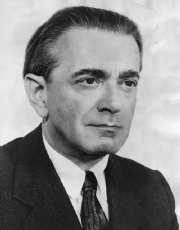
Miklós Rózsa
Miklós Rózsa (April 18, 1907 – July 27, 1995) was a Hungarian-American composer trained in Germany (1925–1931) and active in France (1931–1935), the United Kingdom (1935–1940), and the United States (1940–1995), with extensive sojourns in Italy from 1953 onward. Best known for his nearly one hundred film scores, he nevertheless maintained a steadfast allegiance to absolute concert music throughout what he called his "double life".
Rózsa achieved early success in Europe with his orchestral Theme, Variations, and Finale (Op. 13) of 1933, and became prominent in the film industry from such early scores as The Four Feathers (1939) and The Thief of Bagdad (1940). The latter project brought him to Hollywood when production was transferred from wartime Britain, and Rózsa remained in the United States, becoming an American citizen in 1946.
During his Hollywood career, he received 17 Academy Award nominations including three Oscars for Spellbound (1945), A Double Life (1947), and Ben-Hur (1959), while his concert works were championed by such major artists as Jascha Heifetz, Gregor Piatigorsky, and János Starker.
After completing work on the music for the spy thriller Eye of the Needle (1981), Rózsa's last film score was for the black-and-white Steve Martin film Dead Men Don't Wear Plaid (1982), a comic homage to the film noir films of the 1940s, a genre to which Rozsa himself had contributed scores. Although Rózsa's career as a composer for films ended following a stroke he suffered while on holiday in Italy later that year, he continued to compose various concert pieces thereafter; one of his last works being Sonata for Ondes Martenot, op. 45 (1989).
Rózsa died on July 27, 1995, and is buried at Forest Lawn in the Hollywood Hills. His wife, Margaret, died in 1999, aged 89.